Showing posts with label Japanese. Show all posts

Sunday, October 28, 2012

Hausu (House) (1977) - dir. Nobuhiko Obayashi


Horror films are good. Japanese horror films are even better. But what about a Japanese horror film where a notable point in the story involves a man getting transformed into a giant pile of bananas?

Indeed, it is nearly impossible to prepare oneself for a film like Hausu. Calling this film “bizarre” would be a drastic understatement. It certainly is unlike anything else I’ve ever seen before, and has left me virtually perplexed, yet strangely fascinated. At the same time, the film itself isn’t necessarily “ground-breaking”, as many of the techniques used are recycled and turn the film into something that could easily be brushed off as novelty. It really has something entirely different going for it.


Trying to make sense of its chaotic story would be an act of senselessness in itself. Rather than focus on a coherent plot structure, the narrative chooses to drown it in an abundance of exaggerated special effects and cartoonish editing. Thus, this is a film about story-telling in itself. If one had to put a narrative to it, it would be of a young girl named Gorgeous who is distraught by the fact that her father has remarried. She forms plans with her estranged aunt to visit her in her mansion over summer vacation, and invites her six friends to join.

Overall, this is about as much coherence as can be found in the tale. There is some form of a subplot involving a doomed romance of the past, and even the aunt’s cat Blanche is somehow connected. Eventually, things start to go wrong when the seven girls are essentially trapped in the house, and start disappearing one by one. The first girl, Mac, is decapitated, and her floating head is turned into a watermelon. Later on, a piano eats off the fingers of the girl by the name of Melody, before consuming her body whole. And those aren’t even the weirdest scenes.


It’s really no wonder that this film is as eccentric as it is, given the fact that the director used his young daughter as a source of inspiration for much of the plot. The film does also seem to derive a load of inspiration from other cinema, from every genre imaginable. One of the girls is an expert at kung-fu, and several scenes are devoted to her simply showing off her talents (in a very wacky demeanor). After some time, the narrative itself seems to be derivative of an episode of Scooby-Doo. Even its technical aspects are consciously aware of such influence: montage sequences reminiscent of 1970’s teen comedy, kooky superimpositions of cheesy animated backgrounds, ironic usage of pop music, and unnatural neon lighting, among others. It is during Hausu’s final third when all of these aspects run wild, and create a psychedelic horror universe unlike anything else.

Does this film make very much sense? Not really. However, I think that’s the point. The film itself seems to be very conscious of the fact that it isn’t conventional. Hausu doesn’t seek to scare audiences, or leave them at the edge of their seats, or even to form any sort of valuable ties with the characters or events at all. It seeks to create an atmosphere that is difficult to describe, perhaps hard to swallow, yet oddly poetic in its absolute, nonsensical hybridity. And boy, does it succeed in that.

Saturday, October 27, 2012

Perfect Blue (1997) - dir. Satoshi Kon


Having never seen a single anime I genuinely enjoyed (outside of Studio Ghibli), I'd heard some positive things about Perfect Blue and its director, Satoshi Kon. In actuality, I was not prepared for just how marvelous of a film this really is, and how impacting it would be on my interest in Japanese animation.

Mima is the lead singer of a Japanese pop group, reminiscent of the many girl-bands that had been internationally popular at the latter part of the 1990’s. To the dismay of her fans, she makes a decision to quit the group in order to pursue her dream of being an actress. Her career takes off, but a traumatic experience causes her to slowly lose grip on her sanity. From this point, throughout the rest of the film, the fine line between reality and fantasy are blurred beyond comprehension. This downward spiral is made all the more difficult by a mega-fan - and stalker - by the name of Me-Mania, who attempts to use Mima’s frail condition for his own pleasures.


The amount of emotion and psychological depth presented through its animation is absolutely remarkable. A critic once remarked this as a hypothetical result of Walt Disney’s and Alfred Hitchcock’s collaborative talents; perhaps this description isn’t completely accurate, but the Hitchcockian feel of this work is definitely apparent. At a certain point, the film becomes total chaos; elaborated and convoluted in every way possible. Eventually, the viewers themselves are left perplexed over whether the events are actually part of the movie’s physical story, or simply projections of Mima’s insanity.

However, such incoherence in plot structure is never frustrating or boring. Satoshi Kon succeeds at creating an atmosphere that is both beautiful and enigmatic. Perfect Blue’s setting is in modern-day Japan, a common theme in his films to follow. With such dark city landscapes, embroidered with towering buildings and suspicious streetlights, and blanketed by a billowing darkness, Kon does wonderful things with its animation to convey a realistic depth of field. The visual detail in every aspect of this film, fantasy or reality, carries a dream-like aura, and many scene compositions are produced so brilliantly and really stick to memory.


The amount of influence that Darren Aronofsky retrieved from Perfect Blue is certainly obvious. He bought the rights to the film to reuse the famous bathtub scene in Requiem for a Dream, and the film’s plot is analogous to his Black Swan. And it’s to no surprise, as a film like Perfect Blue really is that impacting. It has created an anime fan in me, something I would not have been able to say previous to my initial viewing. Any fan of psychological drama or nifty animation should not miss this film, as it truly is a gripping, one-of-a-kind experience to be had.

Tuesday, August 7, 2012

Tonari no Totoro (My Neighbour Totoro) (1988) - dir. Hayao Miyazaki


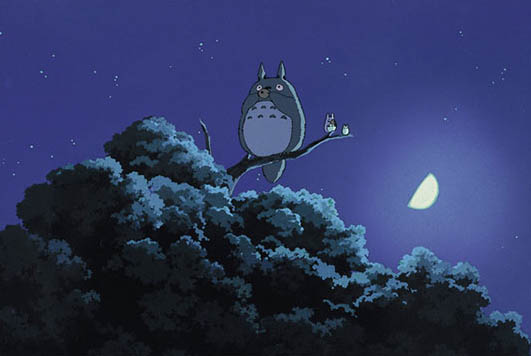
I'll start off this review by simply stating that My Neighbour Totoro is one of the most delightful viewing experiences I've ever had the pleasure of having (if not the most delightful!). From the very start, viewers are introduced by a delightful introduction: an amber-colored title screen, with sprightly animated flowers, rocks, and woodland creatures along the edges. This is accompanied by a peppy background song, with Japanese lyrics that translate roughly to "Let's go for a walk! I love to walk! I have so many friends! I'm so happy!" It is from this point forward that I recognized that the film I was about to watch is atypical of any Disney film I was ever brought up with. I was about to watch a film of a more boundless, childlike aura.

The setting of the film is in a traditional village community in Japan, assumedly during the mid-20th century. Two young girls - Satsuki and her younger sister Mei - have moved in here with their father, in order to remain closer to their mother, who is at a hospital being treated for an unnamed illness. They soon discover that their house is "haunted"by tiny black creatures called "Dust Soots". Soon, Mei encounters two small rabbit-like creatures, who, when she follows them, lead her through the woods, into a large tree. There, she meets a much larger version of these creatures, who she calls "Totoro". The two sisters soon come to the conclusion that this large Totoro is the "keeper of the forest", and the rest of the film revolves their encounters with these whimsical spirits.


Anyone who had ever previously seen a film distributed by Studio Ghibli can expect at least one thing from their films; that being the beautiful animation that all of their films tend to embody. Luckily, My Neighbour Totoro accomplishes this wonderfully. From the birds-eye shots of the trees and clouds of the village, to the intricate detail placed in animating the creatures' faces and movements, the visuals are all-around completely breathtaking. It's no lie that Miyazaki's imagination is seemingly boundless; this could be seen in Spirited Away and Howl's Moving Castle, but I believe that its pinnacle truly lies with My Neighbour Totoro. Another thing to note is the simplistic mood and tone that this film so successfully carries. Unlike most Western children's films, this film does not attempt to spoon-feed some kind of moral message through overbearing tragedy or musical numbers. Although there are so many elements of fantasy, the characters of Satsuki and Mei seem so grounded into reality, that when drama does appear in the story, our feelings toward these characters are completely genuine.

If I had one word to describe this film, and one word alone, that word would be "magical". I don't believe I've ever seen another film that portrays the complete essence of childlike imagination as this one has. This film is, beyond all else, a tribute and homage to the limitlessness of child's imagination. At a certain point of the movie, it becomes apparent that these creatures can only really be seen by these two young girls. To me, this is perfect, because I think that such an imagination could only be exclusive to the innocence and naivety of a child. More importantly, this film is a recognition of how delights of imagination provide a sort of escape from the dismal and dreary. Satsuki and Mei use this new imaginative world of theirs to compensate for the ailing condition of their mother. Near the end of the film, when all hope seems lost, both of the girls turn to their new friends to help them look at the world in a new light, and suddenly, everything doesn't seem so bad.


Since its release in 1988, this film has become a classic among both young children and adults, and for very good reason. The film remains whimsical and charming enough to appeal to children, but with a dignified message and level of pathos that adults can appreciate at all. Moreover, the film is very beautiful to watch. Characters like Totoro and the Dust Soots truly capture what the essence of childhood and imagination is really all about - an escape from hardcore logic and an entrance into a magical world all your own. Because truthfully, the world of a child may be the most magical of them all.

My rating: 5/5