Showing posts with label Soviet. Show all posts

Thursday, December 6, 2012

Krylya (Wings) (1966) - dir. Larisa Shepitko


As we are all too aware of, nostalgia is certainly a powerful phenomenon to come by. In some cases, such a copious embracing of ones past could be so difficult to fully escape. It may perhaps even shape the very person we have become, and make it nearly impossible to maintain any other way of living. Thus is the situation of Nadezhda Petrovna, the protagonist of Larisa Shepitko’s beautiful character study, 1966’s Wings. Upon the first minutes of the film, we learn that she has just been assigned a position as headmaster at a local school. Throughout the film, however, it is presumed that the oppressive atmosphere of the school - and soon, even her life itself - permeates around her like a fog. She seems cold and distant from the world around her for reasons that, for the most part, remain ambiguous. The narrative of the film is peppered by a series of flashbacks and images that reveal Nadezhda’s previous position - that of a prestigious WWII fighter pilot. This excitement of her past fame, and inability to assume the present, has left her blatantly disillusioned; the rest of the film outlines this tragic circumstance, as she desperately clings for something to live for in this inescapable monotony.

Her yearning for the past is further accentuated by the tedious ongoings of her day-to-day life, both in and out of her workplace. The ongoing conflicts that occur between her students, though relatively trivial, are just enough to put a weight on the rest of her day. With her being so lonely most of the time, the slightest notion of disdain from the children is taken with heightened importance. Luckily, such instances are also often accompanied by moments of bliss. In one particularly pleasing scene, Nadezhda volunteers her participation in a school play, dressing up with other students as giant matryoshka dolls. However, such moments are always fleeting, and never promising the prolonged happiness she so desires most.


Another heartbreaking aspect of Nadezhda’s life is shown within the relationship of her estranged daughter. Within the narrative, it is implied that she has grown apart from Tanya, her daughter who has now grown up and married an older man. Near the beginning of the film, Nadezhda attempts to reconnect with her and meet her new husband. Generally, she is unimpressed, and her presence around the two of them is awkward and unstable. She herself, having never married, is in a relationship with a museum curator; though her assumption into this relationship is less formed out of love, than it is in desperate attempt to gain some kind of feeble stance in mainstream society. Nonetheless, she pronounces her feelings of despair to him, proposing that if she had been her real daughter, she would have disowned her. This scene in particular is a rare instance of her peeling back the layers of her exterior, revealing the genuinely disheartened human being that lies beneath.

Altogether, Wings is a story of self-discovery. Although Nadezhda is definitely past her prime, she still remains stuck in a position of absence, unsure how to cope with reality after being hailed as a war hero for quite some time. Her role as a protagonist is unique for this very reason. As viewers, we follow her into her conscious realization of her diminished splendor in the real world. The first time we meet her, she is getting measured for a suit, being told that she is of “standard size”. Though her physical appearance is not without a tinge of sternness that echoes her previous military experience, she is still rather plain. Outside of the war zone, she is simply another representative pawn in the society surrounding her. Later, she hears her name mentioned in a museum exhibit, in regards to her feats of heroism during the war. It is then when she is taken aback by the fact that she herself has made a mark in history, and a fragment of herself is bound to be present far after her death.


Frequently, the narrative presents visuals of planes flying through the sky; the presentation of these very moments themselves is a refreshing break from the oppressive atmosphere that penetrates the film’s story. This is, of course, what Nadezhda most longs for: boundless freedom, the power to return to her roots and live through such stimulation all over again. The thrills of young love and heroism, she feels, are far behind her, or so she presumes. By the end of the film, however, she summons up the courage to leave her position and acclaim a fresh start. She realizes that, although her past is something that could never completely return to her, there also lies an unpredictable future at hand. The ability to sculpt her own little bits of excitement and  pleasures into the everyday is something she still possesses; her life can be whatever she so chooses to make it. For now, however, her passion remains in the skies.

Wings is certainly an important, unique film by an innovative filmmaker, whose life was tragically cut short before given an opportunity to achieve a prominent legacy. Each and every scene is shot with the utmost precision, and although it does move at a slow pace, there is hardly a dull moment. It is not exciting in the conventional sense and nothing very profound happens - yet at the same time, so much is accomplished. The compelling presentation of Nadezhda’s character is mastered wonderfully by actress Maya Bulgakova. Using only natural body language, dialogue, and gestures, she is able to transform into a character who is both emotionally blank and deep in contemplation and desire. The cinematography also effectively captures the various shifts in mood from instance to instance - from the mundane school life, to the soaring shots of planes in the sky. There is truly no other film quite like this one, that so eases through the complexities of a single character-driven story in such a magnificent, poetic manner. Though it has been unfortunately forgotten by many, its overall importance is undeniable.

Sunday, September 9, 2012

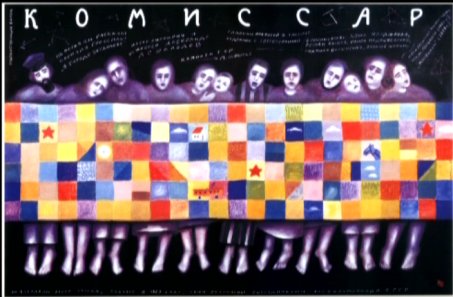
Komissar (1967) - dir. Aleksandr Askoldov


The time and place is the Soviet Union, during the first World War. The Soviets have occupied the Ukraine, the film beginning with the army passing through an abandoned town. Klavdia is introduced; a tough Red Army commissar, who is defined by stabilizing masculinity and utmost patriotism. Not too long after, it is revealed that Klavdia has become pregnant and cannot have an abortion, putting her position in jeopardy. She is sent to temporarily live with a Jewish family: Yefim, his wife Maria, his mother-in-law, and their six young children. Her arrival is not primarily met by open arms; with already much on his plate, Yefim is frustrated by Klavdia’s arrival, especially considering it is her army’s anti-Semitism which put his family in hiding. Not long afterward, however, Maria offers Klavdia a pair of Yefim’s shoes, a symbolic gesture that affirms her acceptance into the household.

This also begins a truly profound journey toward a goal of self-reliance through a sense of a true close-knit community. The family feeds her, clothes her, and soon enough, helps her give birth. It soon really becomes as if she is another new addition to their troupe, a new child to care for and nurture. Their sense of bonding, despite her title, is just one reason why this film was banned upon release. Its positive portrayal of the Ukrainian Jewish people infuriated Communist censors at its time; director Aleksandr Askoldov was told that the single copy of the film was destroyed, and he was banned from filmmaking for the rest of his life. Twenty years later, it was revealed that the film had simply been shelved. It was re-released and eventually won the Silver Bear prize at the 1988 Berlin Film Festival. Had it not encountered such misfortune upon its release, this beautiful work of art would have undoubtedly become a bonafide classic. Its sense of community among indifference and such tremendously staying power nearly guarantee it.


The film is probably most effectively driven by haunting, sometimes disturbing images and scenes injected into the narrative. Many of these scenes involve Yefim and Maria’s children, and their indiscreet moments of playtime. In one particularly disturbing moment, three of their sons find and chase after a young neighborhood girl. They then proceed to “play rape” with her, tearing off her clothes as she squirms and begs, before they tie her to a swing and push. The children play an important role in demonstrating a meditation on the perils of human nature, especially during wartime. As pre-adolescents, they are still very naive, and take in the world around them like a sponge. While a soldier goes into war with the intent to kill to defend his country, there is a filter of society, tradition, and a sense of right and wrong. The young boys remain filterless, and only perform what their abstract idea of playtime is. It is through them that the devastating consequences of a war-ridden world are truly out in the open.

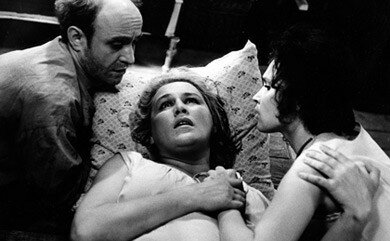
Another important show of images is portrayed during the scene of Klavdia’s birthing. The universal action of giving birth is, essentially, one that is the mother’s alone. Likewise, during her grievous, painful process, Klavdia escapes into her own world, and imagines a flashback scene: a troupe of soldiers pushing a heavy piece of artillery up a hill, engaging in the Communist ideal of “many individuals working as one”. Like her, they are struggling, sweating, and experiencing intense pain. This scene is given great justice, thanks to the film’s truly impressive cinematography. The flurry of emotions in this particular scene are exerted with vigor, aided by camerawork, and the black-and-white surreality makes the viewer unsure whether it is day or night. Images erupt onto the screen: sandstorms, wild horses, implications of sex. This scene is so intense and provocative, when it returns back to Klavdia, the effect is almost jarring. Indeed, Klavdia is tortured by these images, much as she is tortured by her excruciating childbirth. Soon after it ends, Klavdia is shown softly singing to her newborn child, a moment that is beautiful and calming, nearly the polar-opposite of her vision. This is representative of the calm after the storm, an effect that is usually frighteningly eerie during moments of combat. This is also a symbol of hard-earned motherhood, something that, although unwelcome at first, is greeted with open arms by Klavdia.


Essentially, Klavdia gradually learns, through her experiences with the family, the importance of self-identification. As a soldier, she is essentially obliged to blend in with her male comrades, to dress like a man, to talk like a man, to be a man. Throughout the film, however, she spends more and more time with the family, and thus begins to form a sense of self. Rather than revealing a clichéd, polar opposite rendition of femininity, the narrative instead chooses to strip away her calloused image and gradually replace it with one of unbridled vulnerability. Not a woman’s vulnerability, but that of which all human beings, young and old, are accompanied by. This introduces the most prominent conflict in this film: one where she must choose between the life she’s always known as a soldier, or the newfound maternity that has been thrust upon her. She must decide whether to be a “child” of her country, or to take on a new role as “mother”. By the end of the film, she makes her decision in a final, extremely heartbreaking scene. It is a definite show of character, a drastic change from the rigid persona she embodied at the start of the film. It is a decision that she has made for herself and for her child, without the perilous clutch of the government to drag her along. It is a sign of her true development into a strong, independent individual, a true commissar.

This film basically has all the elements one could possibly ask for. Nonna Mordyukova, who plays Klavdia, does so with extraordinary confidence and miraculous vigor. She remains fully convincing of her character and its changes, from beginning to end. Rolan Bykov, who plays Yefim, also does a great job. His character is one that is a bit of a prankster, but still remains loyal and loving to his family and tradition. This is seen in one particular situation, when his children fear for their doubtful fate, he invites them to dance with him, as if it would change the tides and save them. As noted before, the cinematography is mind-blowing. Much like 1957‘s The Cranes Are Flying, this film demonstrates the extraordinary, technical elements that are “ahead of its time”, one of the most remarkable traits of classic Soviet cinema. Over all else, this film is powerful, beautiful, and truly remarkable, and is a necessary viewing experience for cinephiles of all types. Do not dismiss this forgotten gem.

My rating: 5/5